A forthcoming proposal to change the time zone raises an interesting question about how our parliamentary democracy represents the diverse interests of this country.
Putting the clocks forward by one hour will be suggested as part of a government tourism strategy to create more jobs and encourage more visitors. Moving to Double Summer Time would bring the UK into the same time zone as most of the rest of Europe, from Poland to Spain. (Critics of the idea sometimes refer to “Berlin time”, letting us know that their own mental clocks have been put back by 70 years.)
The benefits of this change are said to include greater ease of business with European and Asian countries, as our time would be closer to theirs, and also greater safety and reduced energy costs in the winter because the hours of daylight would be used more efficiently. On the minus side, there is making business with America slightly harder (the flipside of the Euro-Asian argument) and the particular inconvenience that the switch might pose in northern Scotland, where the sun would not rise until 10 am in the winter months.
It is this last point that makes the time change proposal interesting from a democratic point of view.
Democracy as it is conventionally understood rests on the idea that every citizen has an equal say in decision-making, either directly or, more commonly, through the equal right to elect members of a legislative assembly. In giving everyone a vote of equal weight, it assumes that everyone cares the same amount. But is that assumption true?
In the case of foxhunting, it is suggested that, of the majority of the people who are opposed to, most of them do not in fact care very much about it, while for the minority who are in favour, it matters very much indeed. One person one vote systems which aim to reflect the balance of public opinion fail to capture this important fact.
The proposed change in the time zone raises a similar issue. The image below shows the sunrise and sunset times for different parts of the UK at the height of summer (on the right) and on the depths of winter (on the left).
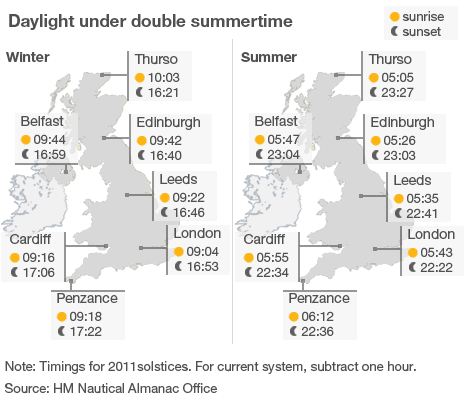
Daylight under Double Summertime (picture from the BBC)
We can see that at Thurso, in the far north of Scotland, the shortest day is only 6 hours 18 minutes, which means that the hour we might change represents 16 per cent of the available daylight. In Penzance in Cornwall, on the other hand, the shortest day is 8 hours 4 minutes, of which an hour is only 12 per cent. It would be stretching the maths too far to claim that to change the use of an hour of daylight matters 33 per cent more in Thurso than it does in Penzance, but one can see that it is nevertheless more significant in the north.
(As with other conservation issues, the cases that matter are where the resource in question is in short supply. When there are daylight hours in abundance, it matters less how efficiently we use them.)
If it matters more to the Scots than to the English which time zone we are on, how can that be reflected in the decision to be taken? There are 533 English MPs and only 59 Scottish ones, for example. The former could simply and crudely outvote the latter. Is that democracy in action?
The normal reaction of federalism is to think of decentralisation. If the English and the Scots have different interests, the issue should be devolved from the UK to national level and they can each decide for themselves. But, even though the English and Scottish interests might be different, there is an over-riding interest for both of them in solving this issue in the same way. For England and Scotland to adopt different time zones would be far more disruptive than either sticking with the current arrangements or moving to the new time zone together.
No, as long as there is a United Kingdom, this has to be a UK decision. But how to take it, when the losers lose more than the winners gain, that remains an awkward question.
¤ ¤ ¤
This criticism of electoral democracy, that it values all opinions equally, can be made even more acutely of the Alternative Vote electoral system. AV permits voters to list the candidates on the ballot paper in order of preference and transfers higher preference votes cast for unpopular candidates onward to more popular candidates in order to find the candidate with more than 50 per cent support. All the votes allocated to a candidate, whether first, second or lower preference, are given the same weight, even though it is likely that the voters care more about their first choices than their later ones. Giving them all the same weight is an over-simplification.
First Past The Post deals with this problem by assuming that the only candidate a voter cares about is the first preference: voters are deemed officially indifferent as between all the others. This is also an over-simplification, and arguably a worse one.


The problem with settling day light saving at a uk level, is that in a close vote English mp’ could be outvoted by scots welsh and irish mp’s acting in their own devolved interests without regard to English intertests.This has happened many times over the last decade or so. only English mp,should have a vote on the time in England. The rest can set their own devolved clocks to suit themselves.
On double summer time, you make a very crude assessment on relative strength in the House of Commons. While Scots MPs are outnumbered 10-1 votes are taken on party lines. Thus Scottish MPs helped to ban fox-hunting in England because it was Labour policy and Labour has a huge majority of the Scottish MPs. More seriously, when Mr Blair introduced top-up tuition fees, the English MPs voted by a narrow majority against and the vote was won only because Scottish Labour MPs, who were not affected by the proposal,voted for it. Similarly, when Mr Brown was PM the Tories put down an amendment to scrap the plans for a 3rd runway at Heathrow. The amendment would have been carried by the English MPs had Mr Brown not appealed for Scottish support to prevent his Govt from being ‘destablised’. Since devolution, the previously introduced Barnett formula, which gives Scotland, Wales & N Ireland a fixed percentage on top of all public expenditure in England the devolved nations have been able to use their extra funds over and above what is spent in England per head to award their electors all sorts of benefits denied to English voters – lower tuition fees, free care for the elderly, no hospital car parking charges etc. Is this ‘democratic’? In a properly federal system, England like the other British nations would decide its own domestic policies.
The trouble with FPTP is that we are presented with fixed menus. Many of us would like a bit of this one and a bit of that one. The winning party however takes its victory as a mandate to implement the whole of its manifesto and nothing at all from those of its opponents. With falling turnout and winning parties taking a smaller and smaller share of the total electorate, something need to be done to mitigate the present exaggerated support for winning parties.
While it is true that AV may hand victory to a party which fewer dislike or care much about, those with fixed interests are at liberty just to put one entry. So if enough people stick to their preferred party there would be little change in the outcome. If the outcome under AV is different then this indicates that there are fewer fixed interest voters. None of the devolved assemblies elects its governments by FPTP. Giving England home rule would provide an opportunity to introduce a better electoral system than AV, perhaps following STV in Scotland.
The only time that matters is that it is time for English independence.
Presently, parliamentary democracy for the English means electing politicians who actively work against the interests of the English people.
The AV system is a typical case in point. It was only a Labour policy, going into the 2010 general election.
The English booted Labour out and awarded the Tories a landslide victory in England. However, the Scots handed Labour victory in Scotland, forcing a coalition government on England.
Now this unwanted coalition is planning a referendum in England on AV, a Labour policy rejected by the English electorate. The tartan tail wags the English bulldog yet again.
Two words will shut up the yack about “localism”, “electoral fairness” and “democracy” not to mention “listening to the people” by Cameron, Clegg and Miliband, and those two words are “English Parliament”.
Every poll carried out by reputable organisations has shown that 60%+ of people in England want an English Parliament. This wish has been systematically suppressed by both politicians and media.
Instead we English are to have a referendum on something already rejected by English voters, namely AV, but are denied a referendum on the one parliamentary reform most of us want, an English Parliament.
So once again the wishes of the English people are ignored, just as they were when Northumberland, County Durham and parts of north Yorkshire booted regional assemblies into the long grass, but nevertheless we had them imposed across all of England.
Many/most English people see no reward from being in the United Kingdom with its British ‘parliamentary democracy’.
“as long as there is a United Kingdom, this has to be a UK decision”
There’s the answer! England and Scotland have drifted far apart. England’s links with Wales and N.Ireland are equally past their sell by date. Dissolve the UK then Scotland, Wales and N.Ireland can do whatever they like. The same applies to England of course.
Dissolve the UK.
Independence for England!
The Time Zone question could be solved for everybody by simply moving to permanent British Summer Time and not changing the clocks. This would provide “Light Summer Evenings” and prevent “Dark Winter Mornings”.
Furthermore, there are more accidents when the clocks change and people’s normal sleep patterns are disrupted.
But in any event, the argument for separate outcomes was decided when Scotland voted for Devolution. England now has every right to decide the Time Zone most appropriate for itself. Scotland is perfectly capable of deciding for itself whether to maintain a separate Time Zone or fall into line with England.
You seem to have missed the fact that it is Berlin time. Paris is about an hour behind its “geographically correct” time zone, so that in January the sun rises there at about the same time as in Edinburgh.
@Matt: In that case, It is less Berlin time (13°23) than it is Vienna time (16°22), Zagreb time (15°59), Prague time (14°25), Ljubljana time (14°30’30) or Valetta time (14°30’45), but somehow one never hears any of these as descriptions of Double Summer Time. I think the choice of Berlin is not motivated by geography.
I’m just joshin’ with ya. I can think of other non-Godwin reasons to use Berlin instead of the other cities, but I’ve never actually heard “Berlin time” outside of this article, so I’m not going to speculate as to the motives of others you might happen to be reading.
However, the list of cities does neatly highlight the absurdity of double, or even single, summer time. Why not stick to GMT all year round, and those who need to do business with Asia or America (or those who simply prefer to shift their free time morningwards or eveningwards) can work earlier or later as appropriate?
Berlin time, here in the Mail on Sunday: http://www.dailymail.co.uk/news/article-1335762/Berlin-Time-Now-Government-swings-Mail-Sunday-campaign-GMT.html