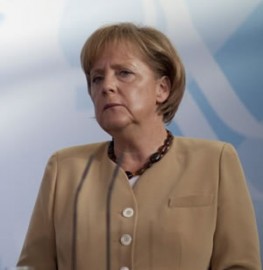
Angela Merkel, chancellor of Germany - has she got what it takes to save the eurozone? (picture European Commission)
A very interesting comment here by Centre for European Reform chief economist Simon Tilford, wondering whether the national governments of the member states of the eurozone have got what it takes for the eurozone to survive.
He is very worried that they have not. They are “wilfully naïve”, he says, if they think that the eurozone might lose one or two members but no more than that. If the eurozone starts to fragment, it will lose Spain, Italy and France as well as Greece and Portugal. Its role as a centrepiece of the European Union as we know it will be at an end.
In a range of policy areas, including debt mutualisation, the role of the ECB as lender of last resort, bank recapitalisation, and economic policies to promote growth, the national governments are behind the curve of developments in the marketplace, leading to the conclusion that
“On current policy trends, a series of sovereign and banking defaults are unavoidable.”
The first four words of that sentence are important, but what will it take for those policy trends to change? The first thing is for national political elites to realise just how serious the crisis is, and the second is that they must realise how their attachment to the old national ways is part of the problem.
My phone buzzed with a call from a colleague objecting to Simon Tilford’s final sentence:
“Indeed, if there is one thing this crisis has shown, it is that the nation-state is alive and kicking in the eurozone.”
The kicking of the nation state, he said, is on the end of a self-tightening noose. The nation states that might come out of this crisis, if they fail to adopt the right policy responses, will be impoverished and enfeebled and unable to help their citizens find their way in the world in the manner that they might have hoped. The whole point of the European Union, from the very earliest days, was that there were things that the national governments could not achieve separately but which they could achieve together. EU institutions and supranational cooperation have proven themselves to be the essential means of making European cooperation work. The crisis of some countries in the eurozone, and the failure of solutions founded on the national states themselves, shows that the need for Europe has not gone away and is in fact stronger than ever.

The devil spits hardest just before he has to go – Thornton Wilder
You have to be joking. Are you aware that the citizens of Europe are demonstrating en masse for democracy or are you sitting on that cloud with the bunch of Euro Dictators?
We don’t want Euro interference anymore. You had your chance, you blew it. You took away too much power from the states and the people want control of their lives back.
To make things worse, the politicos in Brussels inbred need to spend as much taxpayers money as possible on luxuries while the rest of us work for a living, is beyond parody.
Coupled with its inability to even audit its accounts and BE ACCOUNTABLE to those whose money is being forcibly stolen, it has become truly corrupt.
We might need each other in Europe but we can certainly do without the EU parasite sucking the lifeblood from those who have to actually work for a living.
The sooner it is dead and cremated, the better.
Hi Sue
First, I am not representing federalunion.org in replying to you.
Federalism IS democracy. A federal Europe would of necessity be accountable to the people. It is as separate nation states that they are unaccountable, because there are 27 different forms of law. Whose do you apply? A federal EU would be just like a state, in fact, like Italy, where you vote for parliament, president, judges, etc…. and you fire them too! But I understand your frustration. There have been some EU encroachments on state laws that are arbitrary, and also a bit out of the scope of what I, and many others, think the EU should be dealing with. The EU can at times look like some foreign potentate who dictates how the states shall run themselves, from afar. But that is BECAUSE it isn’t federal.
Federalism is a different creature altogether from what you are objecting to. In fact, in a federal union, the states have MORE freedom, because they no longer have to take care of certain transnational problems.
If, as an example, every state in the United States were to have ambassadors to every other state in that Union, that is 2500 ambassadors, leaving aside diplomats and foreign aids. Each of these states would have to be concerned with ambassadors to all other nations in the world too. And all of those nations would in turn be required to send ambassadors to those 50 states. Instead, they have no ambassadors, there is one for all of them.
Then, each of those 50 states would create its own currency, each of which, in the name of nationalism, would create tariffs and taxes on imports, etc, to protect its own interests. That’s how Europe was before the Euro. Alliances would be made between these states, and those states. Arizona would make a treaty with Mexico, while California would declare war on it. I would have to show, not just my ID, but my passport at every checkpoint, in and out, of each state in North America. For the nations sake. At my expense. That’s how Europe was 20 years ago. Hell, when I backpacked through Europe in 2002 this was the case!
Frankly, I wouldn’t be free. To make matters worse, Chicago, having by itself a population the size of Sweden, where I live, would decide to split from Illinois, and to do so, it, as a city, would need a military all its own to defend itself because, well, no one else is going to. All of this is the separatism, nationalism and self-determinism that would have resulted had the Constitution not been written, or had the civil war been lost by the federal government.
If the EU doesn’t unite, the Euro is dead. Literally. If it does unite, as a federal union, you will not only vote in your state elections, but everyone in Europe will then vote on the European federal level for their representatives on that level. We will fire them from their posts if we don’t like them. Europe, in total, will be democratic.
Like I say, it’s a whole different creature. And I understand where you come from. Like the EU, the US federal government encroaches on my rights as a citizen of California often. But the alternative I described above would feel like life under Stalin. Please attempt to protest the unjust encroachments, but not the just aspects of union. In union there is peace.
If you would like to understand more of where I am coming from, go here: http://goo.gl/p1yX2
Maybe federalunion.org can direct you to some of the basics on what federal union is and is not, and how it is democratic in the highest degree.
The post you responded to was about the last dying gasps of a nationalism (from Germany) to avoid giving the people the reigns in Europe, to create a real monetary mechanism for mediating disputes and for holding all EU nations accountable to the people.
Jacob
Thank you Jabob for responding to “Sue” in such a complete way. I would brake it down to inter-governmentalism is by definition not fulfilling the criteria for Rule of Law and can therefore not be democratic. Federalism does NOT automatically lead to more power outside the current nation states, rather it allows the clear demarcation of national and union competencies.
But that conversation needs to be had with the peoples so that they understand that the current half measure is the problem, not “Europe”.
This is completely academic. While ther is an argument ongoing about who it is who should deal with what, the economy is flat-lining. Diseaced parrot. Quite the opposite of “Alive and kicking”.
The great moment of awareness might arrive when FR+DE+NL don’t have enough money to even structure the default of ES+PT+IT+GR. In fact there isn’t enough money on earth. They aren’t fiddling to figure out who’s in charge while Rome burns, because it’s already a smoldering heap of twisted wreckage.
And Sue, those people out there are not “protesting for democracy”. They trying to find some magic lamp that will pay off what they squandered, or had squandered on them. And if what you think is true, them “youth” in Britain believe that democracy is flatscreen TVs, because that was what they were going out and getting for themselves.
Back to the CER report. As I see it, whereas from the start the EU was pursued as a “collegiate” organisation, where the good of Europe over-rode the preferences of individual states, we now have a “consortium” of individual states, each pushing its own ends regardless of the whole. Because of this, national leaders come to the Euro crisis from a strictly nationalistic base: and thus too mindful of their public (uninformed?) criticisms of the EU and the Euro.
The result is that they are always one step behind the “action”; and are unwilling (home politics always to the fore) to take the necessary, collegiate, decisions.