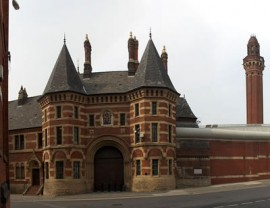
Political hotbed? Entrance to Strangeways prison, Manchester (picture Stemonitis)
There will be a debate in the House of Commons later this week on whether people sentenced to prison should have the right to vote. The issue comes up because the European Court of Human Rights has ruled against the current situation which is that they do not, and the government is under some kind of obligation to rectify its position.
Feelings run high amongst MPs on the subject. Leading Tory backbencher David Davis MP put it like this:
“There are two main issues here. First is whether or not it is moral or even decent to give the vote to rapists, violent offenders or sex offenders. The second is whether it is proper for the European court to overrule a Parliament.”
Taking the second question first, the European Court of Human Rights comes into play because the UK put its name to a convention which included the creation of a court to rule on questions of interpreting that convention. This is what the British government agreed to in 1949, in that peculiar way of the British, under the royal prerogative and without the explicit approval of parliament.
Since then, the Human Rights Act in 1998 has expressly incorporated this system into British law. Is it proper? Well, it is what parliament has voted for. Parliament could change it, but it should beware of the consequences. The notion of human rights is founded on the idea that they should be protected from the whims of politicians; they represent something fundamental about the way our society works rather than something transient or changeable. And, in a democracy, the right to vote is a fundamental human right. We need to ask serious questions about when it is suspended.
The point is that allowing politicians to edit the register of eligible voters poses risks to democracy of its own. Think of Florida in the US presidential election of 2000. The Floridian constitution takes away the right to vote from people convicted of felonies (i.e. crimes punishable by death or imprisonment), even after they have served their sentences.
The rule was introduced in the Reconstruction Era after newly-freed slaves were given the right to vote. Today, something like one third of African-American men in Florida cannot vote. This is unlikely to be a coincidence.
Similarly, Finland introduced a law at the time of the height of fascist influence in 1930 to remove people from the electoral role if suspected of membership of illegal organisations (principally the Communist party). Again, this was a politically motivated move.
I don’t think anyone is suggesting that the debate about whether prisoners in the UK should be allowed to vote is motivated by partisan considerations of the Finnish or Floridian kind, but David Davis ought to acknowledge the human rights considerations that lie behind both the right to vote and the role of the courts in defending those rights.

You have the Florida ruling all wrong. Ex-convicts may ask to be re-enfranchised. LOSING their vote is concidered part fo their sentence, and is also considered good for society in two ways:
1) it promoted good behaviour on the part of a convict, as they have to show signs of being socially rehabilitated to successfully get their voting rights back adter they ask for them.
2) Crime should not have a constituency. No good can come from candidates pandering for votes at the crowbar hotel.
You may not want to hear this, not that it has become mythic in Europe, but any way you count it, Bush won in Florida. Voting stations were not manipulated, black people were not turned away, and the like. The issue was investigated exhaustively by a court appointed investigator, state investigator, and by the press.
The entire campaign to convince people otherwise (Bush STOLE Florida!!!) was a political stunt that EUtopians took as fact because it reinforced their world view. In fact it was Gore’s campaign that tried to gin up enough doubt to put it to the courts.
If you really want to understand the negligent social dynamic of those that cook this kind of thing up (to the obvious disservice of the confidence people have in society,) during the Obama-McCain election, Joe Kennedy simply avered a week before the election to Greg Palast on teh BBC that “McCain ALREADY STOLE the election.” Palast simply smiled and nodded. Europe: that’s where you get the news that lets you smugly tell yourself “that you’re more infomed and wiser” than the rest of humanity.
Donkeys…
An excellent post. Universal adult suffrage should be what it says, and not conditional on the populist likes and dislikes of politicians, even elected ones. Deprivation of a fundamental right such as the right to vote is a serious penalty, not to be imposed lightly, and still less automatically, on top of the even more serious penalty of deprivation of liberty. To say that a murderer or rapist should obviously not be able to vote is to start down a very slippery slope indeed: an authoritarian government (not entirely an unknown phenomenon in Britain, alas) in control of a servile parliament could be tempted to invoke the precedent to remove voting rights from all sorts of people whom it deems to be antisocial and unfit to be allowed to influence the political process: demonstrating students, radical journalists, campaigners against the government on toxic issues — where would it end?
There’s one category of prisoner for whom the deprivation of voting rights is especially and most obviously indefensible: those serving IPPs (indeterminate sentences for public protection) who have served their tariffs and thereby completed the punishment deemed appropriate for their offences, and who are still in prison indefinitely, not as a punishment but in preventive detention, because a group of men in suits is frightened that they might reoffend if released. Some of these have now been in prison for several years beyond their tariffs and have virtually no hope of ever being released, because they can’t satisfy the parole boards that they won’t reoffend if released, and often can’t get places on the courses which parole boards in practice regard as a necessary (but by no means sufficient) condition for release. (More on this if you’re interested at http://www.barder.com/3013.) There’s no possible justification for punishing these people in their private Kafkaesque hell at all, and least of all for depriving them of the right to vote on top of all the other unjust deprivations that they suffer.
It’s profoundly depressing that Ed Miliband’s New Generation Labour seems to be about to try to out-do the Tories on this issue by being even more hard-line than the baying Tory blimps. I wonder what happened to Miliband’s promises that under his leadership Labour would regain the ownership of the title of principal defender of human rights?
Brian
http://www.barder.com/ephems/
We do not have anymore political prisonners, do we have ?
So people now are jailed because they did something “against” our society : crime, rape, robbery, etc..
Vote is a right, but also a duty to participate in our society’s life.
I disagree to let these people participate in something they tried to abuse or destroy, during the whole time they “pay their debt to our society”.
Why should people being held in prison for committing serious crimes be allowed the right to vote when psychiatric patients under section are not?
Even some patients not under section are not allowed leave to vote and believe it or not, not all psychiatric patients are ‘crazy’, some are just stressed or depressed.
In my opinion, the question of prisoners votes should have been put on a back burner until other more important issues are addressed.
Let me ask a question.
Would the fact that Bob the burglar might lose his right-to-vote cause him to pause for reflection and go on the straight-and-narrow? I don’t think so, and if I can be so bold – I don’t think most people would think so either.
As such, vote-denial to prisoners is not really a deterrent – or even a punishment. It is then an unnecessary interference: not only with a prisoners human rights – but with democracy itself.
I would suggest vote-denial for prisoners is all about politics.
Politicians get to give the false impression that prisoners are get an extra punishment – when they don’t really – and pretend they are tough on crime – when they are not really.
Vote denial for prisoners is worse than useless as it will not make It will not make society safer place. However, it will make society a less democratic place, and as such – a more dangerous place.
@Madge: Surely the question is not whether we should ‘give’ prisoners the right to vote, but rather what purpose is served by depriving them of that right? There are positive grounds for encouraging pirsoners to exercise their right to vote, as part of the rehabilitation effort to help them to see themselves as members of society with both rights and duties — an effort which, if successful,can only help towards a reduction in the rates of reoffending. Depriving them of the vote has the opposite effect: it sends a signal that they are regarded as pariahs, excluded from society, deprived not only of their liberty but of the most basic right of a citizen, the right to vote: and if they are treated as being excluded from society, they will be bound to conclude that their duty to society has disappeared with their rights.
If there was a single rational purpose served by taking away this basic right from prisoners, I would be very willing to reconsider the issue. But I have yet to hear or read a single one.
The question of votes for the mentally ill raises completely separate issues. There are several rights which can’t sensibly be exercised by those who lack the mental capacity to exercise them, including the mentally ill and children. For example, such people can’t write or execute a valid will, start judicial proceedings or found a limited liability company (nor vote). Prisoners, unless sectioned, are not in that category. I accept that some psychiatric patients, even some under section, may actually be sufficiently rational to be able to cast a rational vote; but the same is true of some 14- and 15-year-old children, especially girls. The law however can’t in practical terms make exceptions in individual cases and there’s an obvious rationale for withholding voting rights from the mentally incapacitated and from children. It’s just that there’s no such rationale for withholding them from people just because they are in prison.
@Steve Cooke: Hear, hear. Spot on.
Brian
http://www.barder.com/ephems/