
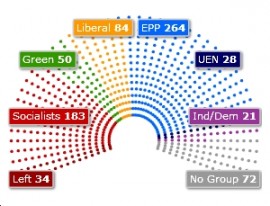
One trick that party politicians sometimes try and play is to say that the turnout was down, which means that you can’t read so much into the result. Pro-Europeans can’t say that because a low turnout is in itself a problem. The fact that the European Parliament does not deal with such high profile issues as Westminster means that one would not expect the turnout to be as high – local elections have lower turnouts than Westminster elections, too – but it is still not something that the pro-Europeans can be particularly happy about.
And then, when one looks at how the votes were cast and not only how many, the news gets worse.
The parties whose share of the vote went up are all, with the exception of the SNP, Eurosceptic parties (at the very least), and the parties whose share went down, with the exception of the Scottish Socialists, are pro-European. (There are figures here.)
The pro-European share of the vote fell to 34 per cent of the vote from 41 per cent in 2004. More than that, the balance on the Eurosceptic side shifted slightly to parties that are explicitly opposed to EU membership. And more than that, the Conservative party, which is by far the biggest Eurosceptic party, is moving closer and closer to a position that is incompatible with EU membership, even if they do not say so explicitly. This may be deliberate, perhaps it is not, but nonetheless it is happening.
The result this weekend was historic and alarming. Up until now, elections have always confirmed broad pro-European support. Every general election since the signing of the Treaty of Rome in 1957, every European election since the introduction of direct elections in 1979, and the referendum on membership in 1975 have all produced a majority in favour of British membership of the EU. It is arguable that, for the first time, a national election may have produced an actual majority against membership.
There will be more debate about why this has happened. It is a sobering thought for now simply to reflect on the fact that it has.